High Energy Laser For
Counter-UAS
Counter-UAS (unmanned aerial systems) refers to the set of technologies and strategies designed to detect, track and neutralize drones. The rapid proliferation of low-cost commercial and military UAVs (unmanned aerial vehicles) has significantly expanded the threat landscape. Small and medium-sized drones can be used for the disruption of critical infrastructure and, of course, in high volumes, for different military scenarios. As a result, effective, scalable and cost-efficient countermeasures have become a high priority for both military and civilian security applications.
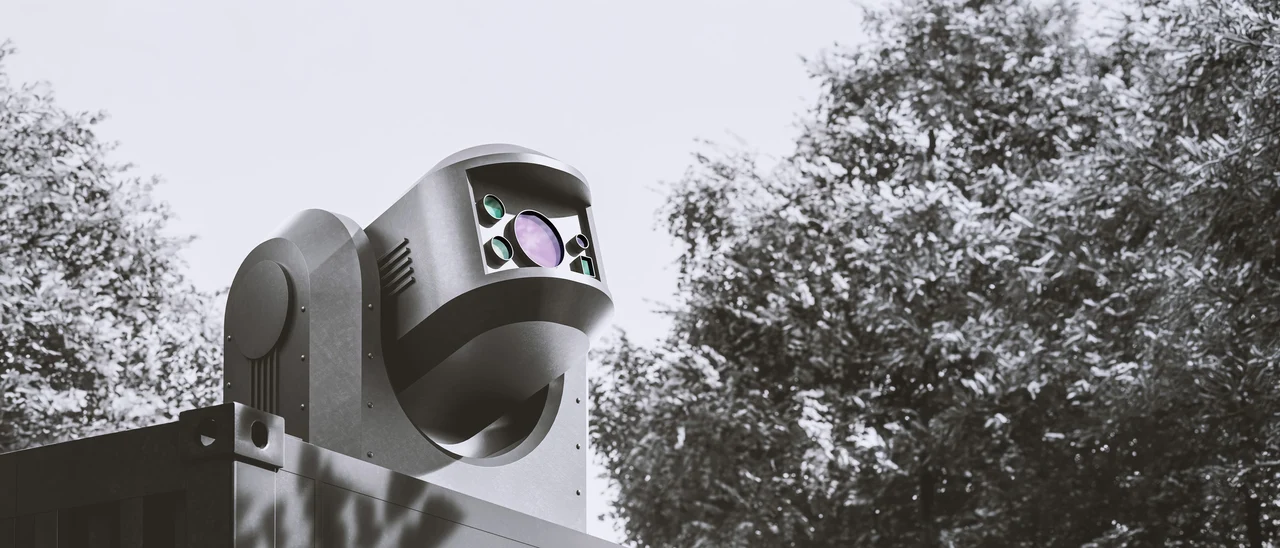
High-energy laser (HEL) systems are a particularly promising hard-kill solution (in contrast, soft-kill solutions could include laser dazzling or the jamming of communication or navigation links). The advantages of HEL systems are substantial. Lasers engage targets at the speed of light, enabling extremely fast reaction times. High-energy lasers offer exceptionally high precision, allowing operators to focus on critical components such as sensors, propulsion units or control electronics. In addition, the cost per engagement is very low compared to conventional munitions, as only electrical energy is required. This facilitates a “deep magazine,” which is especially valuable when countering large numbers of incoming threats, such as drone swarms. HEL technology makes the production, organization and distribution of entire munition supply chains obsolete.
A decisive factor for the effectiveness of laser systems is the laser intensity that is achieved at the target. High laser intensity – defined as optical power per unit area – is essential for the rapid neutralization of a target. This is particularly important in swarm scenarios, where many drones need to be neutralized in rapid succession.
This requirement is further amplified by the operational geometry of swarm defense. Due to the flight speed and intelligent formation of drone swarms, engagement must often begin at relatively large distances – in the order of several kilometers – to prevent saturation of the defense system. At these distances, maintaining the high intensity on target becomes significantly more challenging. Beam divergence, atmospheric losses, tracking limitations and weather conditions (e.g., fog, rain, dust or turbulence) all reduce the effective laser intensity on the target. Therefore, it is crucial to use high laser power in combination with excellent beam quality to ensure that sufficient laser intensity can still be achieved at the target even over long distances (a few kilometers). Given the real-world systems in operation, and the challenges outlined above, lasers in the 20–150 kW range having excellent beam quality (and a high-quality beam director system) are considered highly promising.
Moreover, high laser power and the resulting high target intensity provide greater freedom in selecting the aim point on a UAV – for example, engaging rotors, wings, sensors or cameras –rather than being limited to only the most vulnerable components. This flexibility is essential for a rapid adaptation to evolving drone designs and materials, including more robust structures that require higher laser intensities to achieve effective damage.
To ensure high laser intensity on the target, coherent beam combining (CBC) HEL architectures offer particularly compelling potential. CBC enables the coherent superposition of multiple individual laser emitters into a single beam, effectively scaling output power while maintaining excellent beam quality. Compared to alternative power-scaling approaches, CBC provides superior brightness and focusability, which are critical for achieving high intensity at long distances. CBC-based HEL systems in the power range of approximately 30–150 kW are considered especially relevant, as they are capable of delivering the level of intensity, engagement speed and operational flexibility described above for counter-UAS missions. In addition, HEL systems based on CBC inherently offer the option of atmospheric compensation, which can be critical at distances greater than 1 km.
Beyond its ability to counter drones, a powerful CBC-HEL is also capable of protecting itself. A sufficiently powerful high-energy laser can be used in a defensive role against incoming threats targeting the system itself, including, for example, larger UAVs, artillery or mortars. Whereas these targets are more demanding due to higher speeds, greater mass, different materials and shorter engagement windows, the same principles apply: High power, excellent beam quality, sharp focusing and precise tracking enable rapid energy deposition and potential neutralization or degradation of the threat. Integrating this kind of self-protection capability enhances the survivability and autonomy of the overall system, thus reducing the reliance on additional defensive layers.
In summary, laser-based counter-UAS systems offer compelling advantages of speed, precision, flexibility, supply chain risks and cost efficiency. However, their operational success is critically dependent on achieving high laser power and excellent beam quality. These parameters are essential not only for maintaining sufficient laser intensity delivery over long distances and under adverse weather conditions, but also for generating the high intensity required for rapid neutralization – especially in demanding scenarios such as drone swarm defense. Technologies like CBC further expand these capabilities by enabling scalable power with preserved beam quality, particularly in the 30–150 kW class. Combined with their inherent flexibility and potential for self-protection, high-performance laser systems are poised to play a central role in addressing the evolving challenges of modern aerial threats.
Related Products
Browse Through Related Products To Find Similar Or Complementary Products.